Grab The Discount | Flat Rs1000 off for new learners | Code: OFF1000
GT Academy, now revamped as LearninGT.com

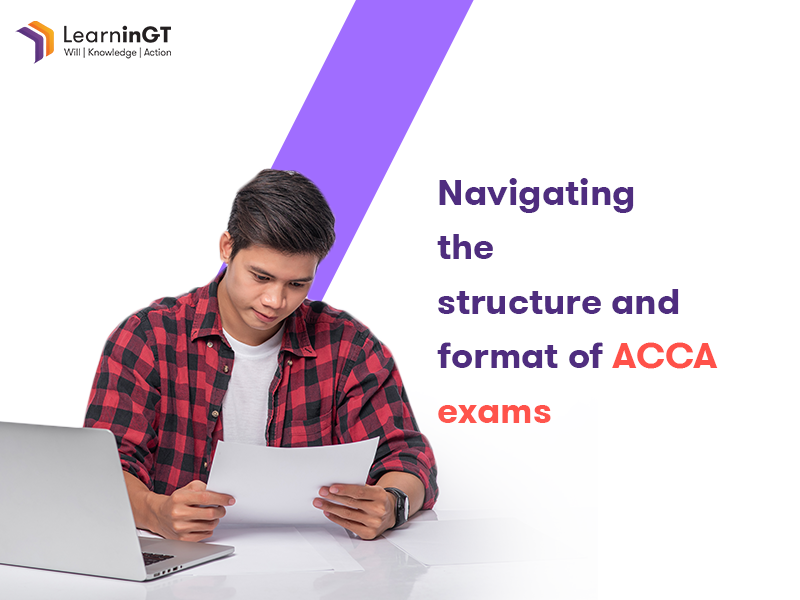
ACCA Exam Structure and Format: Complete Guide
- May 8, 2024
Understanding the ACCA exam structure and format is crucial for effectively planning your qualification journey. To begin with, the path to the ACCA (Association of Chartered Certified Accountants) qualification involves completing 13 examinations divided into three levels: Knowledge, Skills, and Professional.
Depending on your prior qualifications, you may achieve ACCA status within 2 to 3 years by claiming exemptions. Moreover, these computer-based exams (CBEs) can be taken either from home or at designated centres.
Although you can choose the exam sequence, it is essential to pass all exams at one level before progressing to the next. Additionally, each level has its own structure, with multiple-choice questions (MCQs) common in the first two levels. Therefore, a minimum score of 50% is required in each subject, and importantly, there is no penalty for incorrect answers.
The exams are divided into three levels:
Knowledge:
At this level, exams are available on-demand throughout the year. Furthermore, these papers consist entirely of MCQs, testing your grasp of foundational accounting principles. Importantly, each exam lasts for two hours and is compulsory, although exemptions may be granted based on previous qualifications.
| Exams | Pattern |
|---|---|
| Business technology | Section A:46 questions(Each question is marked either 1 mark or 2 marks). Section B:6 questions(Each question carries a weight of 4 marks). |
| Management accounting | Section A:35 questions(Each question carries a weight of 2 marks). Section B:3 questions(Each question carries a weight of 10 marks). |
| Financial accounting | Section A:35 questions(Each question carries a weight of 2 marks). Section B:2 questions(Each question carries a weight of 15 marks). |
Skills:
You can take the Skills Level exams quarterly in March, June, September, and December. This level includes six mandatory exams, although exemptions are possible for certain qualifications. Moreover, the exams combine multiple-choice and subjective questions, designed to deepen your knowledge and apply it to real-world business scenarios within three hours.
| Exams | Pattern |
|
Business and corporate law |
Section A: 45 questions
(25 MCQs for 2 marks, 20 MCQs for 1 mark each)
Section B: 5 questions (5 MCQs/multiple task questions for 6 marks each) |
|
Financial reporting Performance management Financial management |
Section A: 15 questions
(Each MCQ is worth 2 marks)
Section B: 3 case studies (Each question is worth 10 marks) Section C: 2 questions (Each subjective question is worth 20 marks) |
| Audit and assurance | Section A: 35 questions
(Each question carries a weight of 2 marks)
Section B: 2 questions (Each question carries a weight of15 marks) |
| Taxation | Section A: 15 questions
(Each MCQ carries a weight of 2 marks)
Section B: 3 case studies (1 case study is worth 10 marks) Section C: 3 questions (1 subjective question for 10 marks and 2 questions for 20 marks) |
Professional:
At this level, you will take 2 mandatory exams and choose 2 from 4 specialisation options. Furthermore, professional level exams are held quarterly in March, June, September, and December, and importantly, exemptions do not apply at this stage.
| Exams | Pattern |
|
Strategic business reporting
|
Section A: 2 questions (1 question for 30 marks and 1 question for 20 marks)Section B: 2 questions (Each question is worth 25 marks) |
| Strategic business leader | 1 question (3 tasks worth 100 marks) |
Choose any 2: (Advanced)
|
3 questions (2 subjective questions for 25 marks and 1 question for 20 marks) |
Understanding ACCA exam structure and format of each level can help you plan your preparation effectively, enabling practice and revision of key concepts.
As a Gold Approved Learning Partner and Employer by ACCA, LearninGT by Grant Thornton Bharat recognises the demands of the accounting industry. Therefore, our training uses real-world examples, and live projects to prepare aspirants for the dynamic business landscape.
Explore our ACCA programme here.